The Crane That Never Moved: A Story of Housing Projects That Were Supposed to Change a City
By John Oamen, CEO, Cutstruct
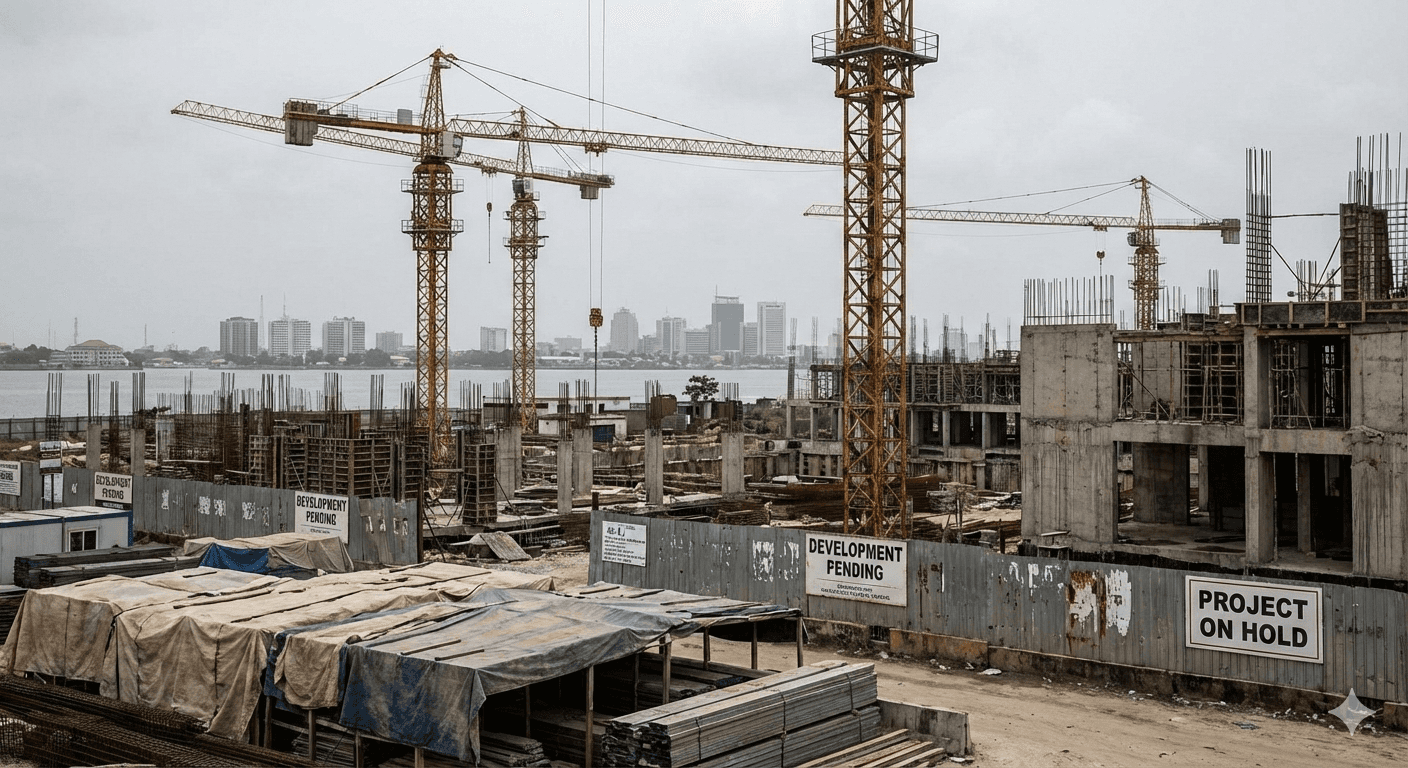
On a busy arterial road in Lagos, fenced plots still promise “Luxury Apartments – Coming Soon.” The billboards remain, their colors faded by the tropical sun. The glossy renderings are untouched. The tower crane stands tall but motionless.
At first, the site is alive. Surveyors mark boundaries. Excavators bite into the earth. The crane swings with purpose. Hope is visible. Then the rhythm begins to falter. Workers thin out. The generator falls silent. Deliveries stop, and the crane freezes in place, not because the vision was wrong, but because the system meant to sustain it quietly failed.
This is the story of many housing projects in Nigeria. Not stories of incompetence or abandonment, but stories of friction, complexity, and a development ecosystem that is still learning how to move at the speed of our urban growth.
An Ambition We’ve Never Lacked
Nigeria has never lacked ambition when it comes to housing. What it has struggled with is scale.
According to the Federal Mortgage Bank of Nigeria (FMBN) and multiple reports by the National Bureau of Statistics (NBS), Nigeria’s housing deficit is estimated in the tens of millions of units, a number that continues to grow as urbanisation accelerates.
The World Bank has repeatedly highlighted Nigeria as one of the countries facing the most intense urban housing pressures in the world, driven by population growth, rural-urban migration, and demographic expansion.
Successive governments have not ignored this reality. The National Housing Fund (NHF), the Family Homes Fund, state-level housing schemes like Lagos HOMS, and a range of Public-Private Partnership (PPP) frameworks all exist because policymakers understand that housing is not just a social good but an economic necessity.
From policy to intent, the direction has been consistent: encourage private sector participation, de-risk development, expand mortgage access, and increase the supply of decent, affordable homes.
The government is trying, and in many cases, genuinely collaborating with developers, financiers, and institutional investors to unlock new models of delivery.
Yet, across our cities, the cranes still stall.
Where Vision Meets Reality
The truth is that most housing projects do not fail at the idea stage. They fail in execution.
They fail in the narrow space between ambition and coordination, between capital and cash flow, between approvals and implementation, between supply chains and site realities.
To understand why the crane stops moving, one must understand the layers beneath it.
Financing: When the Money Comes, Then Disappears
Housing development is capital-intensive by nature. Land acquisition, approvals, infrastructure, substructure, superstructure, finishes, services, and contingencies all require significant upfront investment, often long before a single unit is sold.
In Nigeria, many developers rely on a mix of:
● Off-plan sales
● Short-term bank facilities
● Private equity from small investor groups
● Bridge financing arrangements
When market conditions shift, sales slow, or disbursements are delayed, the project begins to starve.
The Central Bank of Nigeria (CBN) has introduced several intervention funds targeted at the real sector and construction, including facilities designed to support manufacturing and housing delivery.
Commercial banks, development finance institutions, and mortgage banks are increasingly participating in construction-linked finance structures, but long-tenor, low-cost funding remains difficult to access at scale.
The result is predictable: a project that was viable on paper becomes fragile on site. Contractors slow down. Subcontractors demobilise. The crane pauses.
And in construction, a paused project is already in danger.
Approvals and Regulation: Necessary Complexity
Urban development cannot be a free-for-all. Planning controls, environmental regulations, and building standards exist for a reason. Federal and state urban development authorities play a critical role in ensuring safety, compliance, and sustainable growth.
However, when approval timelines stretch, when documentation loops back for revisions, or when inter-agency coordination is slow, projects lose momentum. This is rarely about obstruction; it is about systems still evolving in the face of unprecedented urban pressure.
The government is modernising. Digitisation is improving. Reforms are ongoing. But time, in construction, is money, and every delay compounds risk.
By the time approvals finally land, the market may have shifted, costs may have risen, and the original feasibility may no longer hold.
The crane waits.
The Supply Chain Reality: Where Many Projects Quietly Bleed
Nigeria’s construction supply chain is one of the most under-discussed risk areas in housing delivery.
Despite growth in local manufacturing, the country still imports significant volumes of:
● Steel products
● Finishing materials
● Mechanical and electrical components
● Sanitary ware and fittings
The Manufacturers Association of Nigeria (MAN) has repeatedly drawn attention to the challenges facing local production, including energy costs, logistics constraints, and FX volatility.
Add to this:
● Port congestion
● Customs processes
● Exchange rate fluctuations
● Transportation bottlenecks
And suddenly, a project’s material cost profile becomes unpredictable.
A Bill of Quantities prepared in January can be obsolete by July. A procurement plan can collapse in one quarter. When materials are delayed or unaffordable, site activity slows, even if funding exists.
Fragmentation: Too Many Actors, Too Little Alignment
A typical housing project in Nigeria involves:
● The landowner
● The developer
● Financiers
● Consultants
● Main contractors
● Multiple subcontractors
● Dozens of suppliers
● Logistics providers
● Regulators
● Sales agents
Yet, in many cases, these actors operate in silos, connected by phone calls, WhatsApp messages, and spreadsheets rather than integrated systems.
Information is fragmented. Accountability is blurred. Visibility is limited.
When something goes wrong, no one has the full picture, and by the time clarity emerges, momentum is already lost.
Why Stalled Projects Hurt More Than We Admit
When a housing project stalls, the consequences extend far beyond the fence.
It affects:
● Families who planned to move in
● Investors whose capital is locked
● Artisans and workers who lose income
● Communities left with unfinished structures
● Cities that grow around dead zones instead of vibrant neighbourhoods
The Nigerian Economic Summit Group (NESG) has consistently linked housing delivery to employment, economic growth, and urban stability.
Housing is not just shelter. It is infrastructure. It is dignity. It is an economic activity.
Every crane that stops moving is a story of lost momentum for the city.
The Quiet Evolution in the Industry
Despite the challenges, the industry is not standing still.
Developers are becoming more data-driven, validating demand before breaking ground and structuring projects in phases to reduce risk.
Financial institutions are exploring blended finance models, construction-linked disbursements, and partnerships with development agencies.
Regulators are digitising processes, improving transparency, and strengthening inter-agency collaboration.
And increasingly, technology is stepping into spaces that were previously manual, fragmented, and opaque.
The Role of Platforms Like Cutstruct
One of the most underestimated causes of project delay is cash-flow-constrained procurement.
When developers cannot source materials on time because capital is locked up, timelines slip, sites go idle, and financiers absorb the risk.
By digitising material sourcing, aggregating supplies, and enforcing transparency, platforms like Cutstruct create the infrastructure that allows capital to move with confidence.
This is where construction financing becomes more intelligent.
When material costs are known, availability is visible, and deliveries are predictable, developers can access funding tied directly to real project milestones. Financiers can deploy capital into controlled, traceable procurement flows rather than uncertain site execution.
This is not about replacing people. It is about enabling better decisions.
When developers can:
● Access materials without upfront capital strain
● Lock in pricing and protect budgets
● Coordinate deliveries against funded milestones
● Maintain predictable build schedules
They regain control over cash flow and execution.
And when cash flow aligns with procurement, projects move faster, risks are reduced, and investments become safer.
A Different Way to Read the Crane
It is easy to interpret a stalled crane as a failure. It is more accurate to read it as feedback.
Feedback that the system is still maturing.
Feedback that coordination matters as much as capital.
Feedback that execution is as important as vision.
Nigeria’s cities are growing whether we are ready or not. The pressure on housing will not ease. The demand will not slow. The ambition will not fade.
What must evolve is the infrastructure around delivery: finance, procurement, regulation, logistics, and collaboration.
More to Discover
The Crane That Never Moved: A Story of Housing Projects That Were Supposed to Change a City
By John Oamen, CEO, Cutstruct
On a busy arterial road in Lagos, fenced plots still promise “Luxury Apartments – Coming Soon.” The billboards remain, their colors faded by the tropical sun. The glossy renderings are untouched. The tower crane stands tall but motionless.
At first, the site is alive. Surveyors mark boundaries. Excavators bite into the earth. The crane swings with purpose. Hope is visible. Then the rhythm begins to falter. Workers thin out. The generator falls silent. Deliveries stop, and the crane freezes in place, not because the vision was wrong, but because the system meant to sustain it quietly failed.
This is the story of many housing projects in Nigeria. Not stories of incompetence or abandonment, but stories of friction, complexity, and a development ecosystem that is still learning how to move at the speed of our urban growth.
An Ambition We’ve Never Lacked
Nigeria has never lacked ambition when it comes to housing. What it has struggled with is scale.
According to the Federal Mortgage Bank of Nigeria (FMBN) and multiple reports by the National Bureau of Statistics (NBS), Nigeria’s housing deficit is estimated in the tens of millions of units, a number that continues to grow as urbanisation accelerates.
The World Bank has repeatedly highlighted Nigeria as one of the countries facing the most intense urban housing pressures in the world, driven by population growth, rural-urban migration, and demographic expansion.
Successive governments have not ignored this reality. The National Housing Fund (NHF), the Family Homes Fund, state-level housing schemes like Lagos HOMS, and a range of Public-Private Partnership (PPP) frameworks all exist because policymakers understand that housing is not just a social good but an economic necessity.
From policy to intent, the direction has been consistent: encourage private sector participation, de-risk development, expand mortgage access, and increase the supply of decent, affordable homes.
The government is trying, and in many cases, genuinely collaborating with developers, financiers, and institutional investors to unlock new models of delivery.
Yet, across our cities, the cranes still stall.
Where Vision Meets Reality
The truth is that most housing projects do not fail at the idea stage. They fail in execution.
They fail in the narrow space between ambition and coordination, between capital and cash flow, between approvals and implementation, between supply chains and site realities.
To understand why the crane stops moving, one must understand the layers beneath it.
Financing: When the Money Comes, Then Disappears
Housing development is capital-intensive by nature. Land acquisition, approvals, infrastructure, substructure, superstructure, finishes, services, and contingencies all require significant upfront investment, often long before a single unit is sold.
In Nigeria, many developers rely on a mix of:
● Off-plan sales
● Short-term bank facilities
● Private equity from small investor groups
● Bridge financing arrangements
When market conditions shift, sales slow, or disbursements are delayed, the project begins to starve.
The Central Bank of Nigeria (CBN) has introduced several intervention funds targeted at the real sector and construction, including facilities designed to support manufacturing and housing delivery.
Commercial banks, development finance institutions, and mortgage banks are increasingly participating in construction-linked finance structures, but long-tenor, low-cost funding remains difficult to access at scale.
The result is predictable: a project that was viable on paper becomes fragile on site. Contractors slow down. Subcontractors demobilise. The crane pauses.
And in construction, a paused project is already in danger.
Approvals and Regulation: Necessary Complexity
Urban development cannot be a free-for-all. Planning controls, environmental regulations, and building standards exist for a reason. Federal and state urban development authorities play a critical role in ensuring safety, compliance, and sustainable growth.
However, when approval timelines stretch, when documentation loops back for revisions, or when inter-agency coordination is slow, projects lose momentum. This is rarely about obstruction; it is about systems still evolving in the face of unprecedented urban pressure.
The government is modernising. Digitisation is improving. Reforms are ongoing. But time, in construction, is money, and every delay compounds risk.
By the time approvals finally land, the market may have shifted, costs may have risen, and the original feasibility may no longer hold.
The crane waits.
The Supply Chain Reality: Where Many Projects Quietly Bleed
Nigeria’s construction supply chain is one of the most under-discussed risk areas in housing delivery.
Despite growth in local manufacturing, the country still imports significant volumes of:
● Steel products
● Finishing materials
● Mechanical and electrical components
● Sanitary ware and fittings
The Manufacturers Association of Nigeria (MAN) has repeatedly drawn attention to the challenges facing local production, including energy costs, logistics constraints, and FX volatility.
Add to this:
● Port congestion
● Customs processes
● Exchange rate fluctuations
● Transportation bottlenecks
And suddenly, a project’s material cost profile becomes unpredictable.
A Bill of Quantities prepared in January can be obsolete by July. A procurement plan can collapse in one quarter. When materials are delayed or unaffordable, site activity slows, even if funding exists.
Fragmentation: Too Many Actors, Too Little Alignment
A typical housing project in Nigeria involves:
● The landowner
● The developer
● Financiers
● Consultants
● Main contractors
● Multiple subcontractors
● Dozens of suppliers
● Logistics providers
● Regulators
● Sales agents
Yet, in many cases, these actors operate in silos, connected by phone calls, WhatsApp messages, and spreadsheets rather than integrated systems.
Information is fragmented. Accountability is blurred. Visibility is limited.
When something goes wrong, no one has the full picture, and by the time clarity emerges, momentum is already lost.
Why Stalled Projects Hurt More Than We Admit
When a housing project stalls, the consequences extend far beyond the fence.
It affects:
● Families who planned to move in
● Investors whose capital is locked
● Artisans and workers who lose income
● Communities left with unfinished structures
● Cities that grow around dead zones instead of vibrant neighbourhoods
The Nigerian Economic Summit Group (NESG) has consistently linked housing delivery to employment, economic growth, and urban stability.
Housing is not just shelter. It is infrastructure. It is dignity. It is an economic activity.
Every crane that stops moving is a story of lost momentum for the city.
The Quiet Evolution in the Industry
Despite the challenges, the industry is not standing still.
Developers are becoming more data-driven, validating demand before breaking ground and structuring projects in phases to reduce risk.
Financial institutions are exploring blended finance models, construction-linked disbursements, and partnerships with development agencies.
Regulators are digitising processes, improving transparency, and strengthening inter-agency collaboration.
And increasingly, technology is stepping into spaces that were previously manual, fragmented, and opaque.
The Role of Platforms Like Cutstruct
One of the most underestimated causes of project delay is cash-flow-constrained procurement.
When developers cannot source materials on time because capital is locked up, timelines slip, sites go idle, and financiers absorb the risk.
By digitising material sourcing, aggregating supplies, and enforcing transparency, platforms like Cutstruct create the infrastructure that allows capital to move with confidence.
This is where construction financing becomes more intelligent.
When material costs are known, availability is visible, and deliveries are predictable, developers can access funding tied directly to real project milestones. Financiers can deploy capital into controlled, traceable procurement flows rather than uncertain site execution.
This is not about replacing people. It is about enabling better decisions.
When developers can:
● Access materials without upfront capital strain
● Lock in pricing and protect budgets
● Coordinate deliveries against funded milestones
● Maintain predictable build schedules
They regain control over cash flow and execution.
And when cash flow aligns with procurement, projects move faster, risks are reduced, and investments become safer.
A Different Way to Read the Crane
It is easy to interpret a stalled crane as a failure. It is more accurate to read it as feedback.
Feedback that the system is still maturing.
Feedback that coordination matters as much as capital.
Feedback that execution is as important as vision.
Nigeria’s cities are growing whether we are ready or not. The pressure on housing will not ease. The demand will not slow. The ambition will not fade.
What must evolve is the infrastructure around delivery: finance, procurement, regulation, logistics, and collaboration.
More to Discover
The Crane That Never Moved: A Story of Housing Projects That Were Supposed to Change a City
By John Oamen, CEO, Cutstruct
On a busy arterial road in Lagos, fenced plots still promise “Luxury Apartments – Coming Soon.” The billboards remain, their colors faded by the tropical sun. The glossy renderings are untouched. The tower crane stands tall but motionless.
At first, the site is alive. Surveyors mark boundaries. Excavators bite into the earth. The crane swings with purpose. Hope is visible. Then the rhythm begins to falter. Workers thin out. The generator falls silent. Deliveries stop, and the crane freezes in place, not because the vision was wrong, but because the system meant to sustain it quietly failed.
This is the story of many housing projects in Nigeria. Not stories of incompetence or abandonment, but stories of friction, complexity, and a development ecosystem that is still learning how to move at the speed of our urban growth.
An Ambition We’ve Never Lacked
Nigeria has never lacked ambition when it comes to housing. What it has struggled with is scale.
According to the Federal Mortgage Bank of Nigeria (FMBN) and multiple reports by the National Bureau of Statistics (NBS), Nigeria’s housing deficit is estimated in the tens of millions of units, a number that continues to grow as urbanisation accelerates.
The World Bank has repeatedly highlighted Nigeria as one of the countries facing the most intense urban housing pressures in the world, driven by population growth, rural-urban migration, and demographic expansion.
Successive governments have not ignored this reality. The National Housing Fund (NHF), the Family Homes Fund, state-level housing schemes like Lagos HOMS, and a range of Public-Private Partnership (PPP) frameworks all exist because policymakers understand that housing is not just a social good but an economic necessity.
From policy to intent, the direction has been consistent: encourage private sector participation, de-risk development, expand mortgage access, and increase the supply of decent, affordable homes.
The government is trying, and in many cases, genuinely collaborating with developers, financiers, and institutional investors to unlock new models of delivery.
Yet, across our cities, the cranes still stall.
Where Vision Meets Reality
The truth is that most housing projects do not fail at the idea stage. They fail in execution.
They fail in the narrow space between ambition and coordination, between capital and cash flow, between approvals and implementation, between supply chains and site realities.
To understand why the crane stops moving, one must understand the layers beneath it.
Financing: When the Money Comes, Then Disappears
Housing development is capital-intensive by nature. Land acquisition, approvals, infrastructure, substructure, superstructure, finishes, services, and contingencies all require significant upfront investment, often long before a single unit is sold.
In Nigeria, many developers rely on a mix of:
● Off-plan sales
● Short-term bank facilities
● Private equity from small investor groups
● Bridge financing arrangements
When market conditions shift, sales slow, or disbursements are delayed, the project begins to starve.
The Central Bank of Nigeria (CBN) has introduced several intervention funds targeted at the real sector and construction, including facilities designed to support manufacturing and housing delivery.
Commercial banks, development finance institutions, and mortgage banks are increasingly participating in construction-linked finance structures, but long-tenor, low-cost funding remains difficult to access at scale.
The result is predictable: a project that was viable on paper becomes fragile on site. Contractors slow down. Subcontractors demobilise. The crane pauses.
And in construction, a paused project is already in danger.
Approvals and Regulation: Necessary Complexity
Urban development cannot be a free-for-all. Planning controls, environmental regulations, and building standards exist for a reason. Federal and state urban development authorities play a critical role in ensuring safety, compliance, and sustainable growth.
However, when approval timelines stretch, when documentation loops back for revisions, or when inter-agency coordination is slow, projects lose momentum. This is rarely about obstruction; it is about systems still evolving in the face of unprecedented urban pressure.
The government is modernising. Digitisation is improving. Reforms are ongoing. But time, in construction, is money, and every delay compounds risk.
By the time approvals finally land, the market may have shifted, costs may have risen, and the original feasibility may no longer hold.
The crane waits.
The Supply Chain Reality: Where Many Projects Quietly Bleed
Nigeria’s construction supply chain is one of the most under-discussed risk areas in housing delivery.
Despite growth in local manufacturing, the country still imports significant volumes of:
● Steel products
● Finishing materials
● Mechanical and electrical components
● Sanitary ware and fittings
The Manufacturers Association of Nigeria (MAN) has repeatedly drawn attention to the challenges facing local production, including energy costs, logistics constraints, and FX volatility.
Add to this:
● Port congestion
● Customs processes
● Exchange rate fluctuations
● Transportation bottlenecks
And suddenly, a project’s material cost profile becomes unpredictable.
A Bill of Quantities prepared in January can be obsolete by July. A procurement plan can collapse in one quarter. When materials are delayed or unaffordable, site activity slows, even if funding exists.
Fragmentation: Too Many Actors, Too Little Alignment
A typical housing project in Nigeria involves:
● The landowner
● The developer
● Financiers
● Consultants
● Main contractors
● Multiple subcontractors
● Dozens of suppliers
● Logistics providers
● Regulators
● Sales agents
Yet, in many cases, these actors operate in silos, connected by phone calls, WhatsApp messages, and spreadsheets rather than integrated systems.
Information is fragmented. Accountability is blurred. Visibility is limited.
When something goes wrong, no one has the full picture, and by the time clarity emerges, momentum is already lost.
Why Stalled Projects Hurt More Than We Admit
When a housing project stalls, the consequences extend far beyond the fence.
It affects:
● Families who planned to move in
● Investors whose capital is locked
● Artisans and workers who lose income
● Communities left with unfinished structures
● Cities that grow around dead zones instead of vibrant neighbourhoods
The Nigerian Economic Summit Group (NESG) has consistently linked housing delivery to employment, economic growth, and urban stability.
Housing is not just shelter. It is infrastructure. It is dignity. It is an economic activity.
Every crane that stops moving is a story of lost momentum for the city.
The Quiet Evolution in the Industry
Despite the challenges, the industry is not standing still.
Developers are becoming more data-driven, validating demand before breaking ground and structuring projects in phases to reduce risk.
Financial institutions are exploring blended finance models, construction-linked disbursements, and partnerships with development agencies.
Regulators are digitising processes, improving transparency, and strengthening inter-agency collaboration.
And increasingly, technology is stepping into spaces that were previously manual, fragmented, and opaque.
The Role of Platforms Like Cutstruct
One of the most underestimated causes of project delay is cash-flow-constrained procurement.
When developers cannot source materials on time because capital is locked up, timelines slip, sites go idle, and financiers absorb the risk.
By digitising material sourcing, aggregating supplies, and enforcing transparency, platforms like Cutstruct create the infrastructure that allows capital to move with confidence.
This is where construction financing becomes more intelligent.
When material costs are known, availability is visible, and deliveries are predictable, developers can access funding tied directly to real project milestones. Financiers can deploy capital into controlled, traceable procurement flows rather than uncertain site execution.
This is not about replacing people. It is about enabling better decisions.
When developers can:
● Access materials without upfront capital strain
● Lock in pricing and protect budgets
● Coordinate deliveries against funded milestones
● Maintain predictable build schedules
They regain control over cash flow and execution.
And when cash flow aligns with procurement, projects move faster, risks are reduced, and investments become safer.
A Different Way to Read the Crane
It is easy to interpret a stalled crane as a failure. It is more accurate to read it as feedback.
Feedback that the system is still maturing.
Feedback that coordination matters as much as capital.
Feedback that execution is as important as vision.
Nigeria’s cities are growing whether we are ready or not. The pressure on housing will not ease. The demand will not slow. The ambition will not fade.
What must evolve is the infrastructure around delivery: finance, procurement, regulation, logistics, and collaboration.